
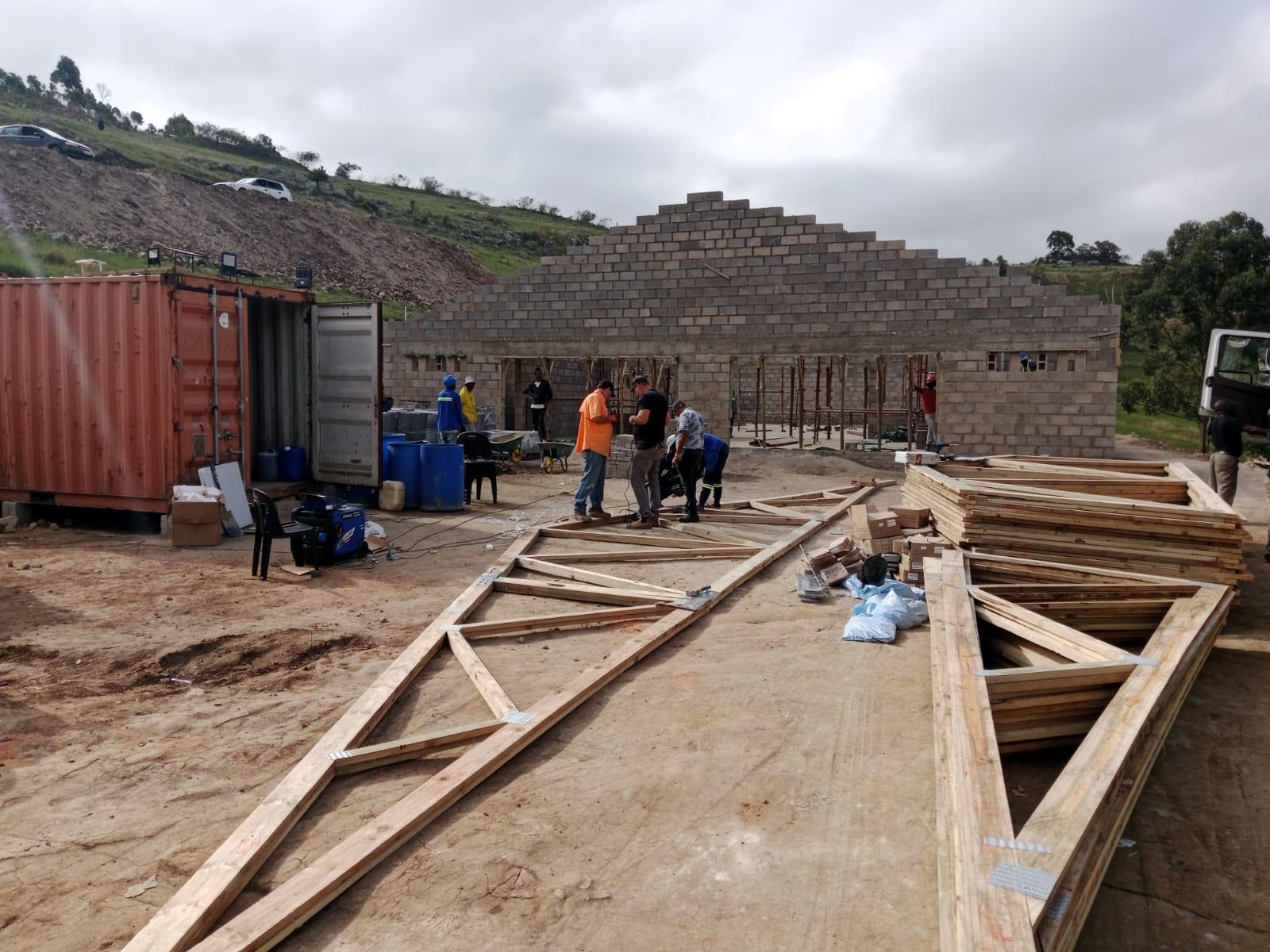
Short answer: for a typical South African house, the timber roof structure (trusses, battens or purlins, bracing and fixings) usually costs somewhere in the region of R250 to R650 per square metre of roof area, before the roof covering goes on. Concrete tiles, clay tiles or IBR sheeting then add their own cost on top. The exact figure for your house depends on the roof shape, the pitch, the covering and how far the trusses have to travel.
This guide explains what drives the price, how to estimate your own roof, and how to get an accurate figure without paying for a design first.
What you are actually paying for
A “roof truss price” can mean very different things depending on who is quoting. Before you compare two quotes, check which of these are included:
- Engineering and design. Every truss should be designed for your specific plans, roof covering and wind zone. At Truss Master this is done on MiTek software and is free with your quote.
- The trusses themselves. Structural SA pine members joined with galvanised nail plates, made in a factory on jigs.
- Battens or purlins. Battens carry tiles, purlins carry sheeting. They are often quoted separately.
- Bracing and fixings. Diagonal and longitudinal bracing, hurricane clips, straps and wire ties that hold the roof down.
- Fascia and barge boards. Sometimes included, sometimes not.
- Delivery. Trusses are long and awkward to transport, so distance from the plant matters.
- Erection. Lifting, fixing and bracing the trusses on site. Many suppliers quote supply only.
- Inspection and certification. The engineer’s sign-off needed for your occupancy certificate.
A quote that looks cheap often leaves out battens, bracing or delivery. A fair comparison is always on the same scope.
Indicative roof structure prices in 2026
The figures below are a rough guide drawn from published South African estimates. They are not a Truss Master quote. Prices move with timber and steel costs, so treat them as a starting point only.
| Item | Typical range | Notes |
|---|---|---|
| Timber roof structure (trusses, battens, bracing) | About R250 to R650 per m² | Excludes the roof covering. Simple gable roofs sit at the lower end. |
| Concrete roof tiles | About R500 to R800 per m² | Supplied and laid. |
| Clay roof tiles | About R600 to R900 per m² | Heavier, so trusses are often spaced closer together. |
| IBR or corrugated metal sheeting | About R450 to R800 per m² | Lighter covering, so fewer trusses are needed. |
| Labour | Often 30% to 40% of the total | Varies by region and roof complexity. |
A worked example
Say you are building a single-storey house with a simple gable roof and a roof area of 150 m². At R300 to R400 per m² for the timber structure, you would budget roughly R45,000 to R60,000 for the trusses, battens and bracing. A hipped roof on the same house could cost 15% to 20% more because it needs more truss types and more labour. Add the roof covering, gutters and ceilings on top of that.
The fastest way to replace an estimate like this with a real number is to send your plans to your nearest Truss Master branch. The quote and the roof design are free.
The seven things that change your price the most
1. Roof shape
A gable roof (two slopes meeting at a ridge) is the most economical, because most of the trusses are identical. A hipped roof (sloping on all four sides) needs hip girders, jack trusses and more cutting, so it costs more. Valleys, dormers and L or T shaped plans add further complexity.
2. Roof covering
Heavier coverings need more timber. SANS 10400-L sets the maximum truss spacing at 760 mm for concrete or clay tiles but up to 1,200 mm for metal or fibre-cement sheeting. A tiled roof can therefore need noticeably more trusses than a sheeted roof on the same house. Read more in our guide to truss spacing, pitch and bracing.
3. Span
The wider the clear span between load-bearing walls, the deeper and heavier each truss becomes. Open-plan living areas, double garages and halls push the span up. Very wide spans may need girder trusses or steel.
4. Pitch
Steeper roofs use longer rafters and more web members, so they cost more. Pitches of roughly 20° to 25° tend to be the most economical, while tiled roofs must stay within the 17.5° to 35° range allowed for tiles.
5. Timber or steel
Timber is usually the more affordable option for houses. Light gauge steel can make sense for long spans, termite-prone areas or commercial work. Our article on timber versus steel trusses compares the two in detail.
6. Delivery distance
Trusses travel on long trailers. Buying from a plant close to your site cuts transport cost and lead time. Truss Master runs plants in Mpumalanga, Gauteng, the Western Cape, KwaZulu-Natal, the Eastern Cape and the Free State, plus a North West branch, and delivers to site on our own trucks.
7. Supply only or supply and erect
Erection by a trained crew costs more upfront, but it removes the biggest risk on a roof: incorrect bracing and fixing on site. It also makes it simpler to get the engineer’s sign-off at the end.
How to keep your roof truss cost down
- Keep the roof simple. Every hip, valley and change of direction adds cost.
- Choose the covering early. Changing from sheeting to tiles after the trusses are designed means a redesign.
- Send complete plans. A quote from full plans with sections is far more accurate than one from a sketch.
- Use a nearby plant. Less distance means lower delivery costs.
- Compare like with like. Make sure every quote includes the same battens, bracing, fixings and delivery.
- Do not cut corners on compliance. A roof that fails inspection costs far more to fix than it saved.
Why the cheapest quote can be the most expensive roof
Roof trusses carry the weight of your roof for decades and must resist wind uplift. In South Africa they must be designed and manufactured in line with SANS 10400-L and SANS 10243, and an engineer has to take responsibility for the roof. Undersized timber, missing bracing or poor nail plate placement can lead to sagging roofs, cracked walls and, in the worst cases, roofs lifting in a storm. Our guide to roof truss regulations in South Africa explains what compliance involves.
Frequently asked questions
How much does a roof truss cost in South Africa?
A single truss can cost anything from a few hundred rand for a small mono truss to several thousand rand for a large girder truss. Because a roof is a system of many different trusses, battens and bracing, it is more useful to price the whole roof per square metre. As a rough guide, the timber roof structure for a house usually lands between about R250 and R650 per m² before the covering.
Is a hipped roof more expensive than a gable roof?
Yes. A hipped roof typically needs more truss types, girder trusses and more labour, so it usually costs more than a gable roof of the same footprint.
Are roof trusses cheaper than building a roof on site?
For most houses, yes. Factory-made trusses use less timber because each member is engineered, they go up faster, and they come with design documentation for sign-off.
How long does it take to get roof trusses?
It depends on the branch and the season. Design and quotation is usually quick once we have your plans, and manufacture then follows. Ask your nearest branch for a current lead time.
Do I pay for the roof design?
Not with Truss Master. The quote and the roof design, including a 3D view of your roof, are free.
Get an accurate price for your roof
Estimates are useful for budgeting, but only a design from your plans gives you a firm number. Choose your nearest branch or send us your plans, and our designers will come back to you with a free quote and roof design.
